
Rainville’s Freshwater
A novel of the War of 1812
Leo-Augustin de Rainville, a disabled Post-Captain on half-pay, is afforded an opportunity to command a ship once more and recover a career he thought was lost to him. When his command is not what he expects, he is forced to adapt or die.
Joined in his mission by a reluctant master, a stubborn boatswain, and an energetic coxswain, Rainville must put his decade of naval experience to the test in the first days of the War of 1812.
The history behind it
At the outset of the War of 1812, Great Britain had her hands full with the Napoleonic Wars. Canada was seen as a backwater post, and every career minded soldier and sailor wanted to be in Europe, or on the high seas, rather than waste away in the frigid northern colonies. However, the War of 1812, while not a grand conflict like the Napoleonic Wars, was an opportunity for many to finally prove themselves.
Being occupied with war in Europe, military affairs in Canada were given a backseat. For the first part of the war, the naval engagements on the lake were controlled by the Provincial Marine, which was actually administered by the Army. This made sense in the context of the lakes, since the ships there were mainly used for supply and transport.
This work favoured small ships, like those featured in Rainville’s Freshwater, which could navigate the shallower waters of the lakes and their adjacent tributary rivers. To supplement the ships, such as schooners and brigs, there were gunboats, which usually contained one gun and was stable, if not fleet.
Many French Canadians served in the Provincial Marine, most notably, perhaps, being Captain Frederick Rolette, who fought at Trafalgar and the Nile, who was the direct inspiration for our daring Captain Rainville.
The three principal ships within this story are all fictitious, invented to display the changing dynamics on the lakes in the opening days of the war. The great men of Frenchtown are also inventions, these two show how, while the war was fought primarily by Americans and the British, it swallowed up many other peoples, including the indigenous, which were also greatly affected by the war. Loyalties, even in one’s own community, might be split, as was shown in the case of Frenchtown.
Cross-cultural adoptions, in both directions, were common, and questions of loyalty and identity became complicated issues for those who were born in one community but raised in another. Familial, social and ethnic boundaries between peoples were much less rigid than we might expect today.
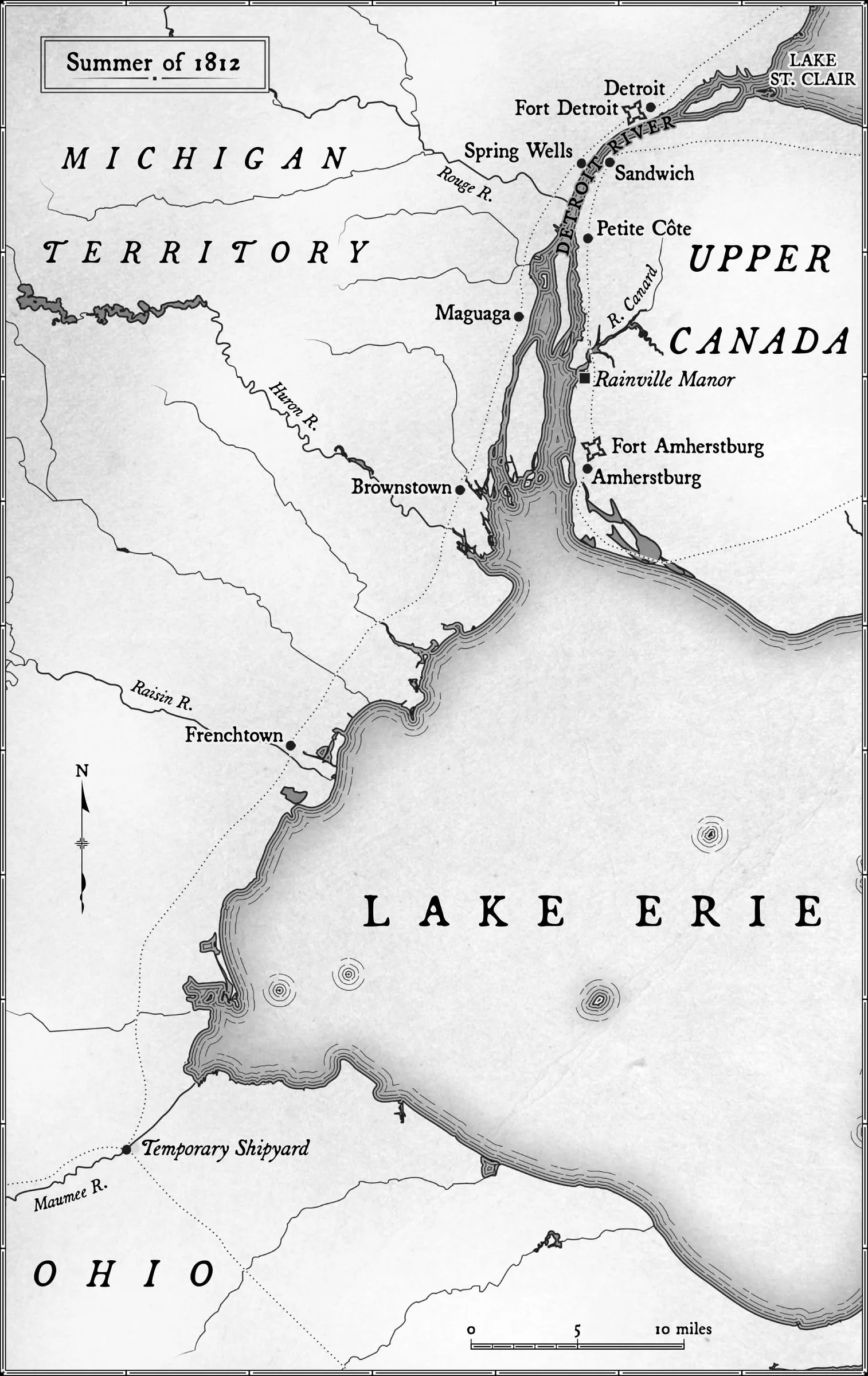
One fact remains clear: the Detroit River region in the early 19th century was a fascinating melange of cultural identities, all trying to survive a war that had been thrust upon them.
Sail along with Rainville as he tries to survive too.